


Colors in Corduroy
Updated: Jun 29
By Grace Thompson
Photo by Sierra Bowman
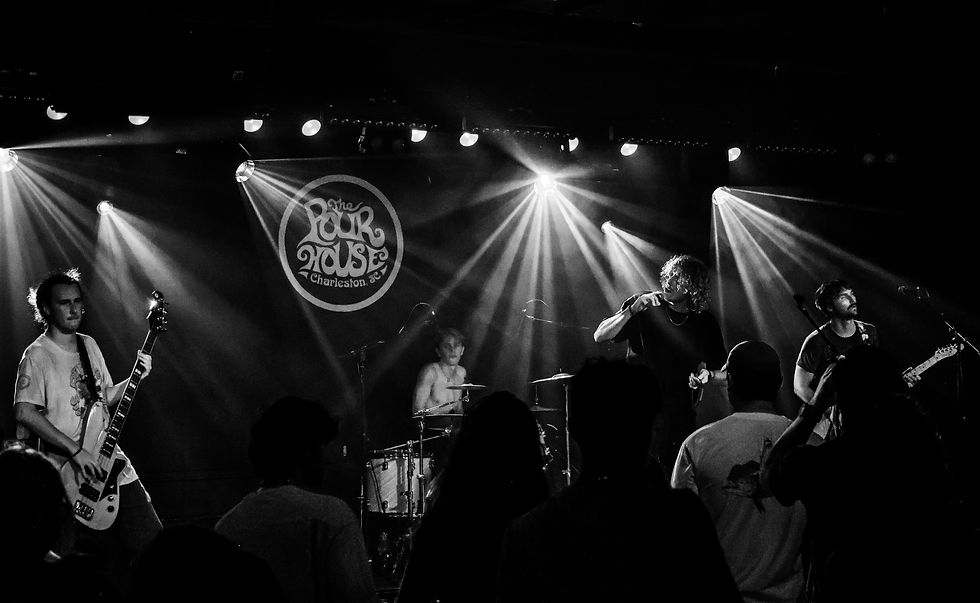
We caught Colors in Corduroy on a Thursday at the Pour House, where they closed out a bill with local bands, Dog Named Squid and Channel Bluff.
As soon as they started playing, the dim-lit room with the faintest smell of cigarettes and beer shifted into something brazen.

"Don’t bring your kids to a Colors show."
-Colors in Corduroy
Not because of explicit lyrics or language, but because the band's chemistry with its audience encouraged a little harmless mayhem.
There was a bewildered energy that grabbed you by the shoulders and pulled you in. Yet, it was a storm that you wanted to be in the middle of.
The crowd shouted back the words as if they had written them themselves.
GRANT MATTHEWS (lead vocals)

I ran into Grant a week after the show, and I had referred to a moment during their set where he had lain down on the stage. Something I grew a bit curious about, but kept untouched to preserve its sacredness. It was this stoic event amid chaos.
He told me he’d never done that before, that it just happened.
Performing forces presence, and for him, it is to be "exactly where his two feet are.”

Grant first got into music during high school, thanks to a friend named Colin, and then started writing songs with Sam Cocolas, who is now the band’s guitarist. He didn’t take singing seriously until college, and he admitted that he was “really, really bad.”
But he loved it.
Going on tour with bands like The Stews and Easy Honey allowed him to see what kind of community music could build. But the impulse came from inside. “Self-accountability,” he said.
“You’re the only person who can make your goals happen.”
In Colors in Corduroy, his voice teeters on grunge and soul.
When asked about his influences, it was a sprawling list: Chris Cornell, Kurt Cobain, Scott Weiland, Marvin Gaye, Aretha Franklin, Charles Bradley, and Etta James. The names crossed generations and genres, and they kept coming.
BOBBY MOSS (bass)

Bobby played like he'd been doing this forever, which, in a way, he had.
He first picked up the upright bass in his fifth-grade orchestra and stayed with it through college. But despite the formal training, he never became overly academic about technique.
"I feel like theory used to make me play robotic. Now, I just try to feel it out."
That instinct carries into every Colors in Corduroy set. Asked about his favorite moment, Bobby refers to the drum-and-bass breakdown at the end of "Desert Queen," which unravels and rebuilds itself differently every show. The appeal, he joked, is knowing it will never sound the same way twice.
It's also that inclination to trust feel over theory that makes him such a steady presence in the band.
Bobby plays with a kind of attentiveness that makes everyone around him better. Onstage, his chemistry with drummer Drake Broadwater comes from listening as much as it does playing. Offstage, he’s often the one reminding others to trust themselves and encouraging bandmates to take creative risks.
SAM COCOLAS (lead guitar)

Slung low across his shoulder, Sam’s guitar looked beat to hell. The setup is Frankensteined together, and it sounds incredible. Seafoam green, an offset body, the neck from a Mexican Tele, and a tweed pickguard ripped off an old amp and nailed into place.
He learned to play guitar from his dad while in high school, just basic cowboy chords and church songs. It was the kind of music that you grow with before you realize what else you’re capable of. Eventually, he did begin to drift into stranger, more expressive territory. Bobby nudged him to lean into that, to get experimental. Now his sound is rough-edged, rousing, and completely his own.

I never saw him stop moving on stage; the only stillness came in quick moments while adjusting his pedal board.
Otherwise, it was a complete blur: leaning, swaying, in the air and on the ground..all while being barefoot.
There’s no formality to his playing, and you can’t pull the performance from the music; it’s all wired together.

Before their set, we were hanging out in the Pour House green room, a bus technically, but really, it was more of a scrapbook of bands past. Stickers everywhere, writing on the walls, names and notes layered like sediment from shows long gone.
Drake was doing rudiments on his sneakers, while the rest of the band joked around, made a few final tweaks to the setlist, and got ready.
DRAKE BROADWATER (drums)

Growing up around his dad's guitar shop in Rock Hill, music was always in the background. Drake first picked up drums through his high school's drumline, where he played marching snare.
"Drumline was great, but I got tired of the conformity. You had to play exactly what was written."
That freedom came later, jamming with friends in his dad's office, where he could experiment and play by feel.
Onstage, Drake is all focus, though every so often a small grin slips through, the kind that comes from getting lost in the music. His drumming is precise but never mechanical; instinct guides his sticks as much as technique.

When asked about a moment that has stayed with him, Drake recalled hugging his friend Preston Hall after performing a Beatles cover with The Stews at the Windjammer.
"Having my whole family there, my friends, and the stress finally being over, it felt amazing," he reflected.
After years of exploring, Drake said the band was finally settling into a sound that felt natural while also balancing control with freedom.
"I'm really happy with how things are sounding, it feels like we're nailing down our sound."
If you haven’t seen Colors in Corduroy yet, you should. Their current releases set the tone for what’s to come, but they’re only the starting point.
The beauty is in how the songs evolve. Played live, they are morphed and shaped by the room. It's as if they're determined by the crowd, making the experience feel personal. With a full set of originals under their belt, it feels like only a matter of time before that energy finds its way into the studio.
Here’s to hoping you don’t have to wait too long.
Photography by Sierra Bowman for Enemy Magazine.
Interviews curated by Grace Thompson for Enemy Magazine.


Comments